Picture a 58-year-old owner of two express exterior tunnels outside Phoenix, both with free vacuums and a busy unlimited membership base. He has fielded two unsolicited offers in the past year, and he wants one straight answer before he responds: what is his car wash value, really? The honest answer is a range, not a single figure. Most car washes change hands somewhere between 3.2x and 6.7x seller's discretionary earnings, according to BizBuySell's 2021-2025 marketplace data, on a five-year median sale price of roughly $857,500. But where a specific wash lands inside that band depends on four things a buyer scrutinizes closely: the type of car wash you run, how much of your revenue recurs through memberships, whether the real estate is part of the deal, and how professionally the sale is run.
What a Car Wash Is Worth in Today's Market
BizBuySell's marketplace data, drawn from car washes actually listed and sold between 2021 and 2025, is the best public benchmark for the value of a car wash. Across those five years, the median business sold for $857,500 against a median asking price of $987,500, on median revenue of about $710,000 and median owner earnings near $200,000. That works out to an average earnings multiple of 4.93x and a revenue multiple of 1.92x in the most recent year, with five-year averages closer to 4.99x and 2.01x respectively.
What stands out is how car washes compare to the rest of the automotive world. Their 4.99x five-year average earnings multiple sits well above gas stations (3.76x), car dealerships (2.90x), and auto repair shops (2.82x). Buyers pay that premium because a good car wash generates high-margin, semi-recurring cash flow from a fixed footprint.
Unlike accounting practice sales, which trade largely on recurring-revenue multiples, car wash value blends operating profit with the physical asset underneath it - which is why professional valuations, including the approach Iconic uses, start with the operating cash flow before pricing the land.
How a Car Wash Is Actually Valued
No single valuation multiple tells the whole story, so a credible car wash valuation triangulates three of them at once. Smaller, owner-operated single sites are usually priced on Seller's Discretionary Earnings (SDE), which adds the owner's salary and personal, discretionary expenses back to profit to show the full owner benefit. Larger, professionally managed or multi-site platforms are priced on adjusted EBITDA, which reflects transferable earnings after a market-rate management cost. Because so much of a wash's worth sits in equipment and land, revenue multiples run modest by comparison and serve mainly as a cross-check.
Here is how those three methods typically break down for a car wash business:
| Method | Typical range | Best fit |
|---|---|---|
| SDE multiple | 3.2x - 6.7x | Single-site, owner-operated washes under ~$2M earnings |
| EBITDA multiple | 3.6x - 6.9x | Multi-site or professionally managed platforms |
| Revenue multiple | 0.5x - 2.0x | Sanity check against the earnings-based figures |
Source: BizBuySell and Peak Business Valuation, 2025-2026
The gap between SDE and EBITDA is where sellers get confused. A wash owner reading a 6x headline multiple may be looking at an EBITDA figure that already deducted a manager's salary, while their own books still bury $150,000 of personal add-backs in expenses. Getting the earnings base right - and documenting the business's financial performance cleanly - often moves the final number more than arguing over the multiple itself.
The Type of Car Wash Drives the Multiple
The single clearest predictor of where a wash lands in its range is the type of car wash. First Page Sage's 2025 analysis prices express exterior conveyor tunnels highest, then detailing, in-bay automatic, full-service, and self-serve at the bottom. At the $1-5M EBITDA tier, express exterior washes average 5.6x while self-serve sites average 4.0x and full-service washes sit around 4.2x. Buyers evaluate each wash type on how transferable and low-labor its earnings are.
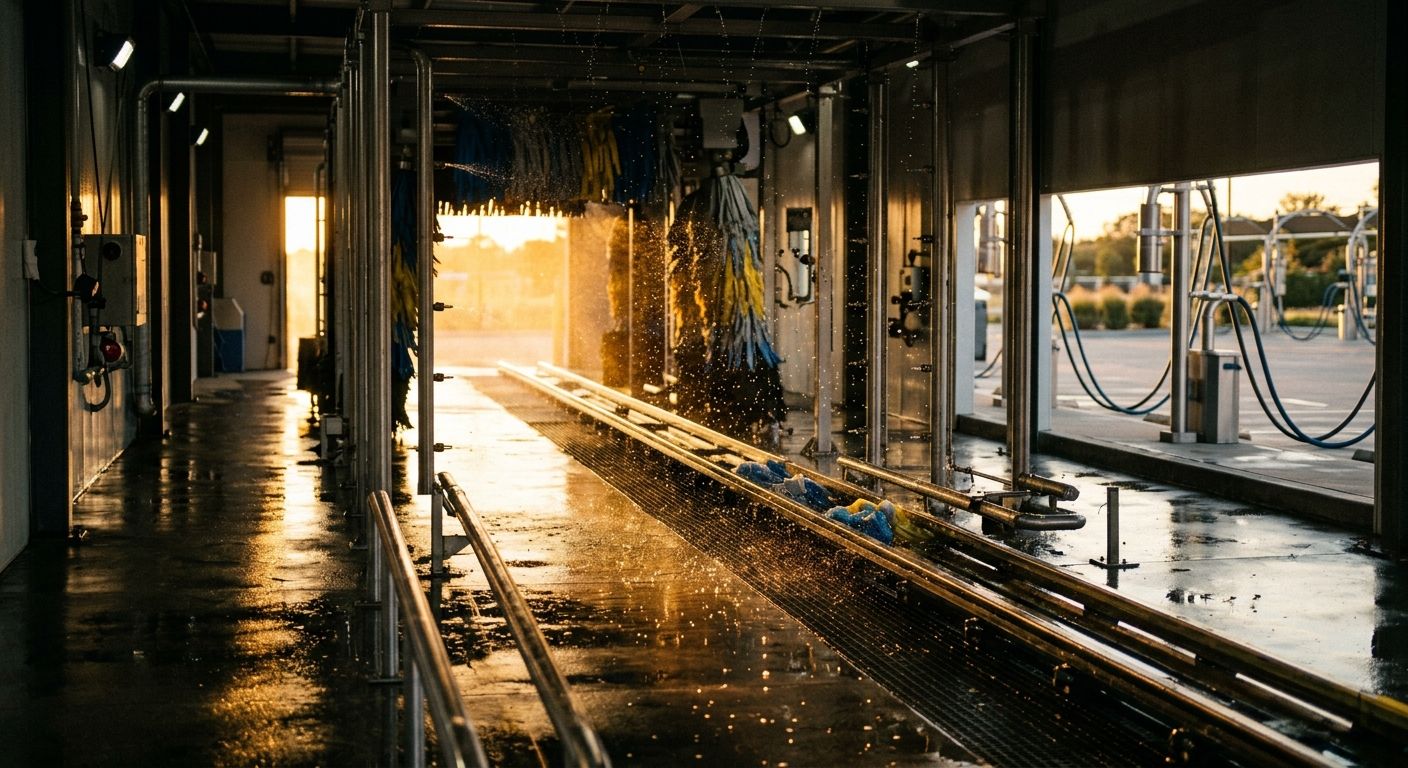
Two forces explain the spread. First, the express wash model - a conveyor tunnel, exterior-only wash paired with free vacuums - moves a high volume of cars at low labor cost, so customers who just want a fast, clean car cycle through quickly and revenue per wash scales. Express exterior tunnels have seen roughly a 1.4x increase in EBITDA multiples since 2020, the sharpest of any format. Second, scale matters within each wash type: multiples climb steadily as an express operation grows, as First Page Sage's 2025 tiers show:
| Express wash earnings tier | Typical EBITDA multiple |
|---|---|
| ~$500,000 EBITDA | 4.3x |
| $1M - $5M EBITDA | 5.6x |
| $5M - $10M EBITDA | 7.0x |
Source: First Page Sage, 2025
Those valuation ranges widen with scale, so a large platform can command well above what an otherwise identical single site earns.
In-bay automatic car wash sites - the single-bay, roll-over machines common at gas stations - fall in the middle, while self-serve bays and older full-service washes with heavy staffing and a standalone detailing service sit lower because their earnings are more labor-dependent and harder to transfer. If you operate under a national brand, a franchise for resale carries transfer fees and brand standards that buyers factor into the offer as well.
Membership Revenue and the Levers That Move Your Number
If format sets the range, recurring membership revenue decides where inside it you land. An unlimited wash club converts a weather-dependent, transactional business into a subscription with predictable monthly cash flow - exactly the profile private-equity buyers pay premiums for. ICA's Q1 2026 CAR WASH Pulse found nearly 90% of unlimited-wash members planned to renew and almost 79% said they would accept a price increase, evidence of how sticky those plans are.
An express car wash where 60-70% of revenue comes from members will price at the top of its band; the same site running mostly single-wash retail will not. In our advisory work at Iconic, membership penetration is consistently the first metric institutional buyers ask about, ahead of raw revenue.
Several other factors compress or expand car wash value: the age and condition of tunnel and vacuum equipment, real estate quality and traffic counts (buyers pay premiums for car washes near dense commuter corridors), labor model, water reclaim systems, and local competition. Add up the recurring revenue, the equipment condition, and the site, and you have most of what determines business value before a buyer ever tours the property.
Real Estate Is Valued Separately From the Business
When a car wash owns its land, buyers and appraisers almost always split the deal into two pieces: the operating business, priced on an SDE or EBITDA multiple, and the real estate, priced separately on a cap rate. Blending them into one number usually leaves money on the table.
Car wash net-lease properties traded at an average 6.21% cap rate in April 2026, on average pricing of $5.11M and an average remaining lease term of 19 years, according to B+E's net-lease inventory data cited in Raymond James' Spring 2026 Car Wash Insight. A 6.21% cap rate on $310,000 of net rent implies a roughly $5M real estate value, independent of whatever the operating business fetches.
For a wash owner who owns the dirt, this matters: structuring a sale-leaseback and packaging the real estate separately can raise total proceeds even when the headline car wash value of the operating business stays flat. It is one of the most common levers an experienced advisor uses when the valuation of a car wash includes owned property.
The 2026 Car Wash Market: Multiples, Deals, and Demand
Multiples have moved with the rate cycle. BizBuySell's average earnings multiple peaked at 5.96x in 2021 during the pandemic-era buying spree, cooled to 4.12x by 2024 as borrowing costs rose, then rebounded to 4.73x in 2025. Median sale prices tell a similar story: against the $857,500 five-year median, the 2025-specific figure slid about 20% to $700,000 as more small washes came to market.
At the top of the market, Mister Car Wash agreed to go private with Leonard Green & Partners at $7.00 per share - roughly a $3.1 billion enterprise value and about 9.0x 2025 adjusted EBITDA, a 29% premium to its prior trading price. CEO John Lai framed the move around growth:
"Taking our company private will help us accelerate our growth by investing more boldly in our stores, our people, and our technologies to capture the multiple opportunities ahead."
- John Lai, Chairperson, President and CEO, Mister Car Wash
That 9.0x institutional multiple matters to private sellers as a ceiling reference, not a comp - a single-site wash will not trade there, but it shows why the modern carwash sector still attracts capital. Deal volume has cooled from its peak: Raymond James counted 39 sites acquired across 17 deals in Q1 2026, down from 397 sites across 20 deals a year earlier. Yet the wash industry remains highly fragmented - the ICA reports roughly 200 companies operate ten or more locations while some 3,000 run just one or two - which keeps roll-up buyers active. Expect a typical listing to take time: BizBuySell's median days on market for car washes is 183 days.
Frequently Asked Questions
What multiple does a car wash sell for?
Most car washes sell for 3.2x to 6.7x seller's discretionary earnings, per BizBuySell's 2021-2025 data, with a five-year average earnings multiple around 4.99x. Express tunnel washes with strong membership bases push toward the top of that range, while self-serve and full-service washes tend to sit lower.
What is the difference between SDE and EBITDA when valuing a car wash?
SDE (Seller's Discretionary Earnings) adds the owner's salary and personal expenses back to profit and is used for smaller, owner-operated single sites. Adjusted EBITDA deducts a market-rate manager's cost and is used for larger, professionally managed or multi-site platforms. The same wash can show very different earnings under each method, so always confirm which base a quoted multiple applies to.
How long does it take to sell a car wash business?
Plan on roughly six to twelve months from preparation to closing. BizBuySell reports a median 183 days on market for car wash listings, and due diligence, buyer financing, and negotiation add time on either side. Washes with clean financials and documented membership revenue tend to move faster.
What is Mister Car Wash's EBITDA multiple and why does it matter for private sellers?
Mister Car Wash agreed to go private in 2026 at about 9.0x 2025 adjusted EBITDA and a $3.1 billion enterprise value, according to Raymond James. For a private seller it is a reference point, not a comparable - single-site washes trade at lower multiples, but the deal signals that institutional capital still values the sector highly, which supports roll-up demand for quality independents.
What to Do Before You Sell
Your car wash value ultimately comes down to a handful of variables you can influence before you ever talk to a buyer: the format you run, how much of your revenue recurs through memberships, the age and condition of your equipment, and whether you package the real estate with the operating business or sell it separately. Get those documented and defensible, and you control most of the number.
The practical first step is an honest earnings base - clean books, clear add-backs, and a membership report a buyer can trust. From there, a broker or M&A advisor can model the SDE, EBITDA, and real estate pieces and reconcile them into a defensible range. Iconic has guided more than 200 businesses through the sale process, and you can start with a complimentary business valuation to see where your wash lands before you decide to sell your car wash. Know your range, tighten your recurring revenue, and go to market when the numbers - not the calendar - say you are ready.