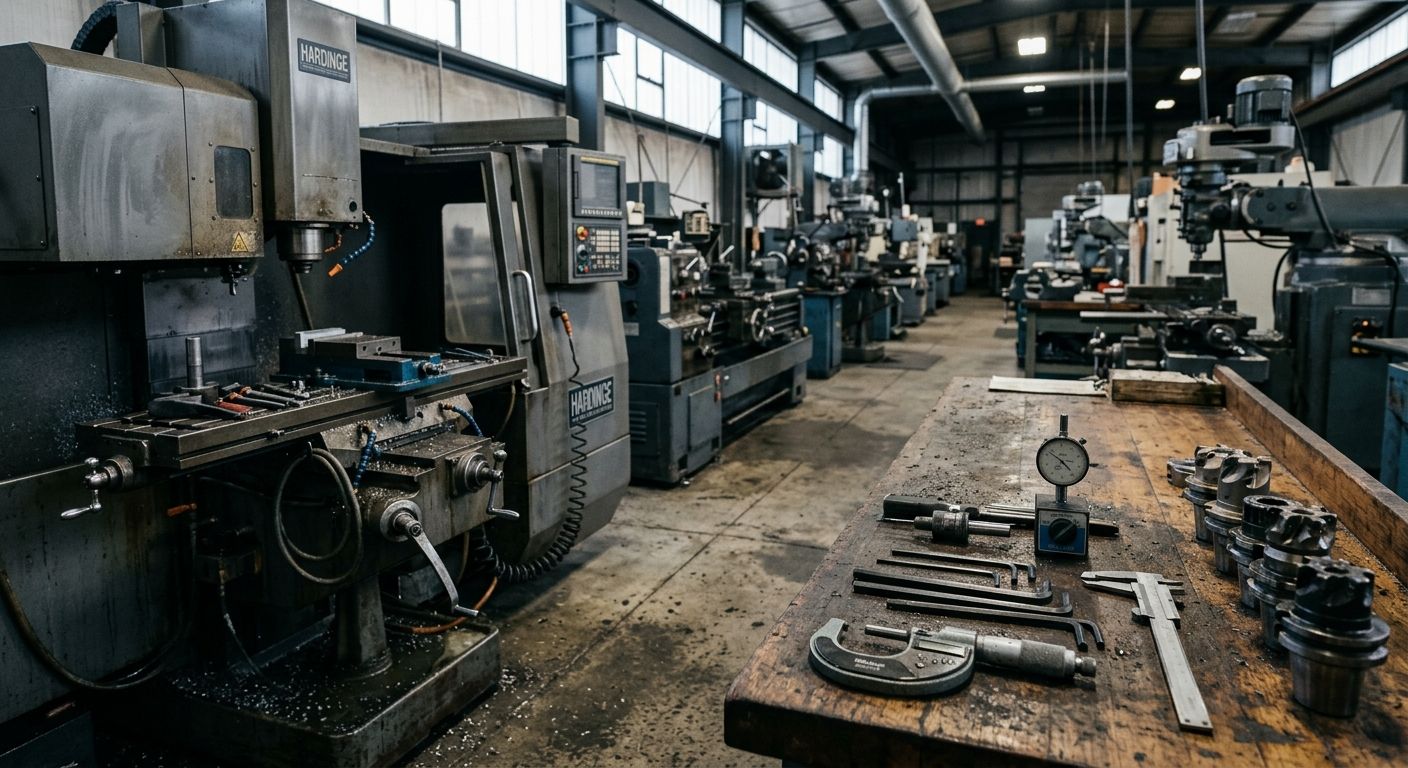
A 63-year-old owner of an $11 million precision machine shop in Ohio has spent three decades building a business that runs on tacit knowledge, long-tenured machinists, and a handful of blue-chip contracts. When he starts weighing retirement, his first instinct is to call the same generalist business broker who listed his neighbor's restaurant. That instinct usually leaves money on the table. Specialist firms like Accelerated Manufacturing Brokers exist precisely because selling a manufacturing business is not the same transaction as selling a storefront, and the advisor you choose can move your final number more than almost any other decision you make.
Why Manufacturing Deals Reward a Specialist Broker
A manufacturing company is a different animal to price and sell than a service business. Value sits in machinery, tooling, work-in-process inventory, real estate, and customer contracts as much as in the profit-and-loss statement, and a buyer's diligence turns on capacity utilization, equipment life, and customer concentration. Within the broader business brokerage world, a generalist who mostly lists restaurants and retail stores rarely has the vocabulary for any of that, let alone the buyer network to reach the strategic buyer or private equity group most likely to pay a premium. That is why manufacturing business brokers who specialize in this asset class operate as a distinct category rather than a sub-menu on a generalist's shelf.
That gap shows up in the data. Manufacturing did not crack the top five industries for Main Street activity in the IBBA Market Pulse Q4 2025 survey, but the same report named it a leading player in lower-middle-market transaction activity - the exact band where specialist representation and a competitive buyer pool matter most. The specialization logic is the same one that governs accounting practice sales or any vertical where buyers underwrite on industry-specific metrics rather than generic cash flow.
The seller demographics reinforce the point. Baby Boomers accounted for 59% of business sellers in IBBA's Q3 2025 data, and generational dynamics increasingly shape how sellers and buyers reach agreement. As Brian Stephens, an intermediary at Legacy Venture Group, put it in that report, "Buyers in their 30s and 40s may be more metrics-driven and acquisition-oriented, while long-time owners tend to value relationships and legacy." A specialist broker translates between those two worldviews. At Iconic, having served 200+ businesses through the process, we see the same pattern repeatedly: the advisor's real job is to package a founder's decades of institutional knowledge into the metrics a modern acquirer will actually underwrite.
Inside Accelerated Manufacturing Brokers' Model
Accelerated Manufacturing Brokers has served the manufacturing sector since 1994, starting as manufacturing equipment auctioneers before transitioning exclusively into M&A work - a lineage that explains its comfort with asset-heavy businesses. By its own account, the brokerage firm specializes in selling manufacturing companies nationwide, generally in the $5 million to $50 million revenue range, with a focus on founder-led and family-run sellers. It operates on a commission-based model with no upfront fees, vets prospective buyers before making introductions, and describes a full sale process that can run one to two and a half years, with owners often asked to stay six to 12 months after closing.
The firm markets a valuation approach it says weighs more than 175 data points rather than relying on a backward-looking, financials-only calculation. Treat that as the company's stated methodology, not an industry standard - and note that Accelerated Mfg. Brokers does not publish an aggregate closed-deal count or a success rate, so its track record is best judged through direct reference checks rather than headline claims. Professional memberships in the IBBA, M&A Source, ACG, and AM&AA are a reasonable baseline credential to confirm for any manufacturing specialist you interview.
The backdrop for firms like this is a fragmented, aging market. U.S. Census Bureau data has counted roughly 246,155 firms in the manufacturing sector, all but about 3,960 of them considered small, with more than three-quarters employing fewer than 20 people and the sector supporting some 12.4 million workers. That is a vast pool of owner-operators, many of them Boomers now weighing whether to sell to a competitor, a private-equity platform, or a next-generation operator - a very different buyer profile than someone shopping a franchise for resale.
What Manufacturing Businesses Actually Sell For
There is no single manufacturing multiple - the number you should expect depends almost entirely on your deal size, and mixing the bands is the most common way owners set the wrong expectation. Among smaller, Main Street manufacturers sold on BizBuySell between 2021 and 2025, the average earnings (SDE) multiple was about 3.0x, with a lower quartile of 2.04x and an upper quartile of 3.59x, a median sale price near $700,000, and a median 207 days on market. Move up to the lower middle market and the numbers climb: IBBA's Market Pulse Q3 2025 data put the $2M-$5M segment at roughly 5.3x and the $5M-$50M segment at 6.5x, up from 4.0x and 5.0x respectively in 2022. Larger private manufacturers changing hands through private equity networks command more still - First Page Sage pegged buyer-offered EBITDA multiples around 10.2x to 11.1x, a band that has nothing to do with a sub-$1M shop.
Sub-sector matters too. BizBuySell's benchmark data shows rubber and plastics manufacturers averaging 4.06x SDE against 2.55x for sign manufacturers - nearly a 60% spread inside the same broad "manufacturing" label. This is why a credible manufacturing business valuation blends an asset-based floor (the machinery, equipment, and real estate a buyer could recover) with an income-based multiple that reflects earnings quality, rather than defaulting to one method. It is the mirror image of pricing an asset-light company; contrast the equipment-driven math here with how to value a software company, where recurring revenue and retention carry the number. That same discipline - anchoring an asset-based floor under an earnings multiple - is the foundation of the business valuation Iconic prepares before an owner ever goes to market.
Frequently Asked Questions
What is Accelerated Manufacturing Brokers and what size companies do they work with?
Accelerated Manufacturing Brokers is a manufacturing-specialist M&A brokerage that has operated since 1994, working with manufacturing companies nationwide that generally fall in the $5 million to $50 million revenue range. The firm concentrates on founder-led and family-run lower-middle-market sellers and works on a commission basis with no upfront fees. As with any advisor, confirm current terms and references directly, since aggregate deal statistics are not published.
How much does it cost to use a manufacturing business broker?
Lower-middle-market brokers commonly charge a "Double Lehman" sliding-scale success fee, and flat rates near 4% are typical on larger deals (roughly a $400,000 fee on a $10 million sale). Minimum commissions in this segment generally run $50,000 to $150,000, versus 8%-12% for sub-$1M Main Street businesses. Most manufacturing specialists take no upfront fee and are paid on close.
What multiple does a manufacturing business typically sell for?
It depends on size: sold Main Street manufacturers averaged about 3.0x SDE from 2021 to 2025 (BizBuySell), while $5M-$50M lower-middle-market sellers reached roughly 6.5x in IBBA's Q3 2025 data. Always match the multiple to your revenue band and earnings metric, because SDE-based small-deal multiples and EBITDA-based middle-market multiples are not interchangeable.
Why hire a manufacturing-specialist broker instead of a generalist business broker?
A specialist understands asset-based value, customer concentration, and equipment condition, and maintains a buyer network of strategic acquirers and private-equity platforms that a generalist rarely reaches. That combination tends to produce more competitive bidding and a cleaner diligence process. The trade-off is a smaller local footprint, so weigh specialization against your specific situation.
How long do sellers typically need to stay on after a manufacturing business sale closes?
Buyers commonly ask sellers to stay six to 12 months after closing to transfer relationships, systems, and institutional knowledge. The full process - from preparation through close - often runs one to two and a half years, so most owners should plan the exit well before they intend to leave.
Timing Your Manufacturing Sale in a Volatile Market
Recent M&A activity in manufacturing has been anything but steady, which is why no single quarter should set your expectations. BizBuySell's own marketplace data on completed business sales swung from a Q1 2025 surge - median manufacturing sale prices topping $1 million on reshoring and tariff-driven demand - to a Q3 2025 pullback, with transactions down 11% and the median price falling to $550,000, then to a Q2 2026 reading of $704,500, down about 10% year over year as buyers prioritized performance quality over volume. Small sample sizes make these medians jumpy, so durable planning should lean on multi-year averages rather than the latest headline.
Source: BizBuySell Manufacturing Valuation Benchmarks; IBBA Market Pulse Q3 2025
Zoom out and the structural demand is real. PwC's 2026 midyear outlook put industrial manufacturing M&A at roughly $173 billion over the trailing year, up 28%, driven by AI infrastructure, grid modernization, and defense investment - though that figure reflects large-cap strategic deals, not the lower-middle-market transactions a founder-led shop runs through a broker. For most business owners, timing is less about calling the market top and more about being prepared: clean financials, documented processes, and a valuation grounded in current comparables. The advisor's job in the M&A process is to get the business market-ready so it can move when the right buyer appears, not to wait for a perfect quarter that may never arrive.
What To Do Next
The firm you hire matters, but the underlying choice is simpler than the brand names suggest: pick an M&A advisor who genuinely understands how asset-heavy manufacturing companies are bought, priced, and transitioned. Whether you interview Accelerated Manufacturing Brokers, another manufacturing specialist, or a broader M&A advisory firm, ask each one how they build a valuation, who sits in their buyer network, and what a realistic timeline and fee structure look like for a business your size - then confirm references from owners who have already sold.
Most business owners will only sell once, so the preparation you do before signing with any broker is what protects your number and eases transitioning ownership. If you want a defensible baseline before you start interviewing, begin with a complimentary business valuation from Iconic and use it to compare approaches, test each advisor's assumptions, and decide how and when to bring your manufacturing business to market.